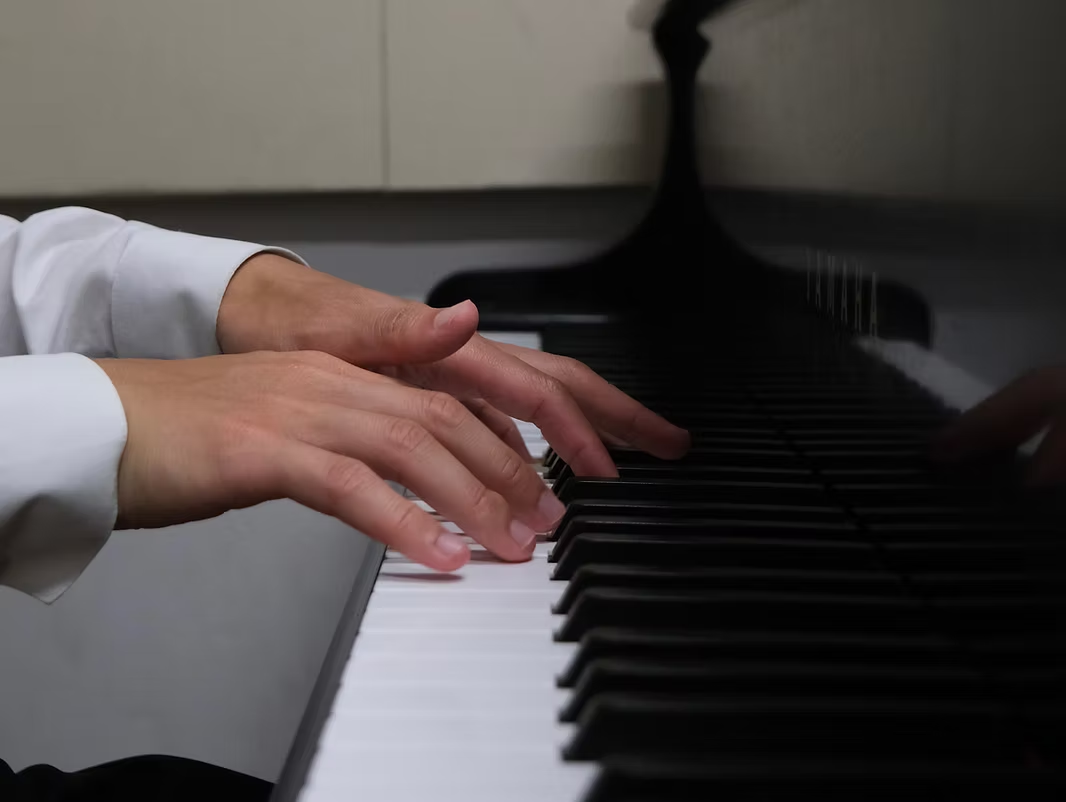
Reflections on Piano Practice|The Flow
Have you ever noticed that when you’re completely absorbed in something, time seems to pass unusually fast? That sensation likely means you’ve entered a flow state.
The concept of flow was first introduced by psychologist Mihály Csíkszentmihályi in 1975 as part of positive psychology. In essence, when we are fully engaged in an activity, our consciousness takes the lead while the body operates almost automatically. Everything feels smooth and natural. During this state, we may even lose awareness of external distractions, such as hunger or fatigue, until the task is complete. Only then do we realize how much time has passed and feel a deep sense of satisfaction and joy.
While the feeling that “time flies” is subjective, the truly important part is that this heightened concentration significantly enhance efficiency. So, how can we apply flow to our daily piano practice?
Csíkszentmihályi proposed three key conditions for entering flow. I’d like to share how these can be practiced during piano study, along with some personal reflections:
1. The activity must have clear goals and measurable progress.
Spending time at the piano is certainly important, but time alone doesn’t always equal results. Even if we practice daily, progress can be limited without a clear purpose. Many tend to play from beginning to end without setting specific goals or time frames to address problems. Instead, practice becomes most effective when we focus on precise objectives, for instance, working on a passage, a phrase, a bar, or even a single note, to directly improve weaknesses.
It may sound simple, but many students unconsciously play through to the end without any target, leaving problems unresolved. This not only wastes valuable practice time but can also reinforce bad habits. Rather than repeatedly playing, it’s worth pausing to ask: “What exactly am I practicing?”
2. The task must provide clear and immediate feedback.
“I could play this perfectly yesterday! Why can’t I play it today?” Surely many have shared this frustration. This often stems from a lack of consistency and immediate feedback during practice. Every subtle movement and thought affects stability in playing.
Piano performance isn’t just about finger motion, it’s more about the coordination between awareness and physical action. To achieve the desired tone, speed, and control, we must consciously guide our body and feel how each action produces a result. From fingertips and wrists to arms, shoulders, back, and even leg and foot support, combined with breathing and relaxation, our movements become more connected and controlled.
When each practice session builds upon consistent and mindful movements, progress becomes clearer and more sustainable. Even seemingly subconscious motions can benefit from awareness and adjustment, helping us gain mastery more efficiently and paving the way for the flow state to emerge.
3. A balance must be maintained between the perceived difficulty of the task and one’s skill level. Confidence in completing the task is essential.
For students, it’s not always easy to set suitable goals on their own—this is where a teacher’s role becomes crucial. As mentioned in my previous reflection on repertoire selection, teachers can help establish goals that are both challenging and achievable, allowing students to progress step by step, think critically, and explore possibilities.
After all, compared to weekly lessons, daily practice forms the true foundation of learning. If a teacher can provide the right framework of thinking and timely encouragement within limited lesson time, it helps students build confidence and inspires them to explore independently at home. This kind of growth and transformation is, in itself, a deeply rewarding achievement.
Certainly, flow is only one of many psychological concepts. Yet if a method helps us stay more focused, engaged, and effective in learning, it’s worth trying. Try taking a few minutes before your next practice to plan your goals and time frame. You may find yourself entering a more concentrated state and discover that piano practice is not merely a daily routine, but a dialogue with your inner self and a journey of refinement.